
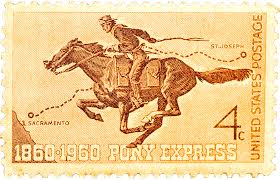
The Pony Express
The Pony Express was one of the fastest ways to send messages across the country in the 19th century. Riders physically carried handwritten letters over long distances, facing many dangers along the way to deliver them.
This system is considered analog because the information in the letters is represented in a continuous form, such as handwriting. Unlike digital systems, which use a finite set of discrete values, the Pony Express does not encode messages into a fixed set of symbols for transmission. Instead, it transports physical documents whose appearance can vary continuously.
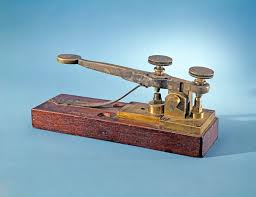
Telegraph
With the invention of the Telegraph, long-distance messages became much easier and faster to send and receive. Instead of physically transporting letters, messages could travel almost instantly through electrical signals, as long as both the sender and receiver understood Morse Code.
Morse code is a system based on two basic symbols: dots and dashes. Because it uses a finite set of discrete values, this makes the telegraph a digital communication system. Each letter is encoded as a specific sequence of these symbols, allowing text to be transmitted in a standardized way.
The telegraph worked by sending electrical pulses through wires that were installed across long distances. These pulses represented the dots and dashes of Morse code, which were then decoded back into letters on the receiving end.
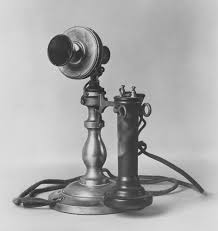
Early Telephone
The early Telephone was an analog system designed to transmit a person’s voice over distance using a microphone and receiver. When someone spoke into the microphone, their voice (sound waves) was converted into continuous electrical signals. These signals varied smoothly to match the shape of the original sound waves and were transmitted through wires to a receiver on the other end, which converted them back into sound.
Because the signal changes continuously and is not limited to a fixed set of discrete values, the early telephone is considered an analog system.

Modern Telephone
The modern Telephone is a digital system because it converts sound into a finite set of discrete values before transmitting it. When a person speaks, their voice is first sampled at regular time intervals. Each sample is then quantized, meaning it is rounded to the nearest value from a fixed set of possible levels rather than an infinite range.
These values are encoded into binary data (0s and 1s), transmitted, and then reconstructed on the receiving end to reproduce the sound.
Because the system represents sound using a fixed number of possible values rather than a continuous signal, the modern telephone is considered digital.
Trade offs:
Pony Express VS Telegraph
Early VS Modern Telephone
Trade offs:
- Slower delivery
- Not limited in what can be sent
- No encoding required
Trade offs:
- Faster Delivery
- Limited to fixed symbols
- Encoding Required
Trade offs:
- Smoother quality
- Cannoot filter out noise
- Limited to voice transmission
Trade offs:
- Filters out noise better
- can randomly cut out instead of noise
- Not limited to voice transmission
Sources & Prompt
Prompt:
Explain the advantages and limitations of a digital representation in a historical as well as modern context.
Sources: